
God Is One — Father, Son & Holy Spirit — Is the Trinity in the Bible?
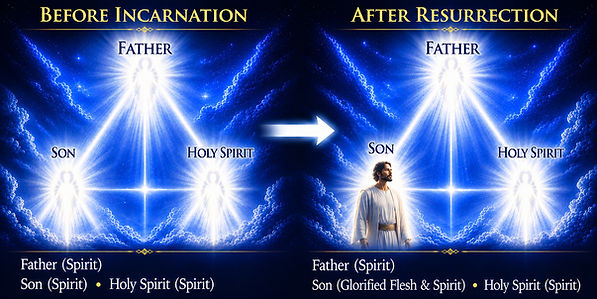
A visual summary of the Bible passages discussed in this study.
Note, lapis lazuli is God's color, Exodus 24:10
Summary
Scripture reveals one God as Father, Son, and Holy Spirit. This study examines the Bible passages that reveal this, without adding human tradition.
The Father, the Son, and the Holy Spirit are all present in the Old Testament, though God chose to reveal them more clearly through Jesus Christ and the New Testament. Later terms such as Trinity simply attempt to summarize what Scripture collectively reveals.
God did not change from the Old Testament to the New Testament. The Son became flesh to accomplish the salvation God had promised from the beginning.
About This Study
This study is not affiliated with any denomination. It is based entirely on the Bible and reflects the teaching of the Father, the Son, and the Holy Spirit. All conclusions are drawn directly from the full context of Scripture, with clear references so readers can examine the evidence for themselves.
Contents
-
Why the Old Testament Strongly Emphasized One God
-
God Is One in Scripture
-
The Father, Son, and Holy Spirit
-
Jesus Existed Before Becoming Flesh
-
What “Begotten” Means
-
Why Jesus Prayed to the Father
-
The Hierarchy Within the Triune God
-
The Father, Son, and Holy Spirit in the Old Testament
-
Was Jesus Created?
-
What “Firstborn” Really Means
-
John 1:1 − The Word Was God
-
Why God’s Nature Is Difficult for Humans to Fully Understand
1. Why the Old Testament Strongly Emphasized One God
Throughout the Old Testament, God repeatedly emphasized to Israel that He alone was God.
Deuteronomy 6:4
Hear, O Israel: The Lord our God, the Lord is one.
This emphasis was extremely important because Israel was surrounded by nations that worshiped many false gods, idols, and regional deities.
Again and again, Israel was warned not to follow the gods of surrounding nations.
Exodus 20:3
You shall have no other gods before Me.
The focus was first to firmly establish that there is only one true God.
Even with this strong emphasis, Israel repeatedly fell into idol worship and followed false gods such as Baal and Ashtoreth, grieving God throughout much of the Old Testament.
Because of this, the Old Testament heavily emphasized the oneness of God and separation from pagan polytheism.
Later, through Jesus Christ and the New Testament writings, God revealed more about His eternal nature through the Father, the Son, and the Holy Spirit.
This did not introduce a new God or multiple gods. It revealed more about the nature of the One eternal God already worshiped throughout the Old Testament.
2. God Is One in the Old and New Testaments
Summarizing the key verses from Scripture.
2.1 Before Becoming Flesh, God was all Spirit - Father (Spirit), Son (Spirit), & Holy Spirit (Spirit)
John 1:1
…the Word was with God, and the Word was God.
Jesus was there, and was God! “Was” - meaning before He became flesh.
John 1:14
And the Word became flesh and dwelt among us.
The Son becoming flesh was part of God's eternal plan of salvation.
2.2 After resurrection, still Three Persons but with Jesus in the Flesh - Father (Spirit), Son (Flesh & Spirit), Holy Spirit (Spirit)
1 Peter 3:21-22
... the resurrection of Jesus Christ, who has gone into heaven and is at God’s right hand—with angels, authorities and powers in submission to him.
A magnificent supreme Being capable of creating our universe and intelligent life is not easily explainable. We are created with only a fragment of His infinite intelligence. All we know about Him is what He revealed to us in the scriptures.
★ The New Testament explains this more fully that His Spirit extends to the Son Jesus and to the Holy Spirit.
If someone rejects this simply because terms like “Triune” or “Trinity” were later used by churches to describe it, then they are focusing more on arguing against people than on genuinely understanding Scripture.
3. The Father, Son, and Holy Spirit
3.1 One God — Three Persons
There are many verses in the New Testament clearly describing God as three Persons in One God, not just a couple of church-twisted ones! Here are a few:
Romans 1:2-4
Paul: … His Son, who was descended from David according to the flesh and was declared to be the Son of God in power according to the Spirit of holiness by His resurrection from the dead, Jesus Christ our Lord
John 1:18
No one has ever seen God, but the one and only Son, who is Himself God and is in closest relationship with the Father, has made Him known.
Luke 1:34-35
The angel answered [Mary], “The Holy Spirit will come on you, and the power of the Most High will overshadow you. So the holy one to be born will be called the Son of God.”
Matthew 28:18-19
Jesus: “...All authority in heaven and on earth has been given to Me. Therefore go and make disciples of all nations, baptizing them in the name of the Father, and of the Son, and of the Holy Spirit...”
3.2 The Son Became Flesh
John 1:14
The Word became flesh and made His dwelling among us.
Jesus became Flesh, as was Planned before the Foundations of the World.
After resurrection, Jesus was seated in the flesh at the right hand of the Father.
Matthew 28:18-19
After resurrection, Jesus said: “...Therefore go and make disciples of all nations, baptizing them in the name of the Father, and of the Son, and of the Holy Spirit...”
In other words, going forward, stop baptizing in the name of God (as Jewish people up to John the Baptist obviously did), and start baptizing in the name of the Triune God.
3.3 The Term “Triune”
The word “Triune” is not directly written in the Bible. It is a later one-word theological term used to summarize what Scripture collectively describes about God.
The Bible reveals One God, and also:
-
the Father as God
-
Jesus the Son as God
-
the Holy Spirit as God
★ Because of this, terms such as “Triune” and “Trinity” were developed as shorthand descriptions of the biblical revelation.
The terms themselves are not the foundation — Scripture is.
4. Jesus Existed Before Becoming Flesh
4.1 Was With the Father Before the World Existed
Jesus was not created—He has existed in Spirit eternally, just like the Father. It also means He did not come into existence when Mary gave birth to Him.
Many Bible verses confirm this.
John 16:28
"I came from the Father and entered the world; now I am leaving the world and going back to the Father."
John 17:5
Jesus: “And now, Father, glorify me in your own presence with the glory that I had with you before the world existed.”
1 Peter 1:20 NASB
“For He [Jesus] was foreknown before the foundation of the world, but has appeared in these last times for the sake of you.”
The NASB translation (not associated with church tradition) is one of the official word-for-word translations from Aramaic & Hebrew to English.
“Foreknown” means He was with God before becoming flesh.
4.2 “Before Abraham Was, I Am”
John 8:58
Jesus said to them, “Truly, truly, I say to you, before Abraham was, I Am.”
“I Am” is the name God gave during the interaction with Moses at the burning bush.
Which meant Jesus was identifying Himself with the eternal existence of God.
5. What “Begotten” Means
“Begotten” refers to Jesus’ salvation accomplishment as the Son in the flesh. God the Father declared Him “begotten” after His suffering, death, and resurrection.
5.1 Jesus Called His Suffering a “Baptism”
Jesus called His suffering, death, and resurrection, “a baptism”.
Luke 12:50
Jesus: “But I have a baptism to undergo, and how distressed I am until it is accomplished!”
Jesus was speaking about His suffering and crucifixion that still had to be completed.
5.2 “Today I Have Begotten You”
Psalm 2:7 & Acts 13:33
“…You are my Son; today I have begotten You.”
Paul in Acts 13:33 was confirming that “today” in Psalm 2:7 refers to the day after Jesus’ suffering, death, and resurrection.
In other words, through His accomplishment of suffering, death, and resurrection, Jesus became Baptism-confirmed as “God the Son in the Flesh” and became begotten at that moment.
Just before His death on the cross, Jesus said:
John 19:30 “It is finished.”
The salvation accomplishment leading to His “Begotten” status had been completed.
But God the Father did not have to wait for time to pass to see that moment! He saw it eternally past and prophets prophesied about it in Psalms. God does not live in time. He’s outside of it. This is why we trust what He says. Because our limited minds cannot fathom the complete structure of God.
6. Why Jesus Prayed to the Father
Jesus already said, “the Father is greater than I.” There should be no surprise in Him praying to the Father here. Many people still try to force God into simple human categories, even though Scripture consistently presents God as far beyond human understanding.
6.1 Why Did Jesus Ask for the Cup To Be Removed?
Luke 22:41-43
He withdrew about a stone’s throw beyond them, knelt down and prayed, “Father, if you are willing, take this cup from me; yet not my will, but yours be done.” An angel from heaven appeared to him and strengthened him.
The Bible says Jesus was fully God and fully human. In His human state He became weak. Which explains why God sent Him an angel to strengthen Him.
Jesus had the full emotional characteristics of a human. He cried when His friend Lazarus died. He expressed hunger many times, like at the fig tree passage and when He fasted for 40 days. There too angels attended to Him to keep Him going. He also became angry when people disgraced the House of God with their buying and selling.
God became flesh and dwelt among us! John 1:14
He really did, in every way!
6.2 Why the Father Did Not Remove the Cup
It was not about God refusing Jesus’ request.
It was about God the Father having a salvation plan since before the foundations of the world, to be completed. And He was not about to change it due to His own human side weak moment.
Isaiah 53:6
… the Lord has laid on Him the iniquity of us all.
God the Father laid all our inequities on the Son, and punished Him instead of us.
★ It is appalling and sad how some people can even think of twisting this verse “Father, if you are willing, take this cup from me..." to claim, “therefore Jesus is not God.”
7. The Hierarchy Within God
In terms of the hierarchy of our God, Jesus said throughout the Bible that He was doing the will of the Father. So equal in Spirit, yes. But different in roles and greatness.
7.1 Equal in Spirit — Different in Roles
John 14:28
Jesus: ".. for the Father is greater than I."
John 14:8-9
Philip said to Him, “Lord, show us the Father, and it is sufficient for us.” Jesus said to him, “Have I been with you so long, and yet you have not known Me, Philip? He who has seen Me has seen the Father.”
Matthew 24:36
But about that day or hour no one knows, not even the angels in heaven, nor the Son, but only the Father.
★ Jesus Himself openly said that the Father is greater than Him. This is not secret “aha” information hidden from Christianity—it is already part of the Bible’s own explanation of the relationship and hierarchy between the Father and the Son!
7.2 The Role of the Holy Spirit
Luke 11:13
Jesus said: “If you then, though you are evil, know how to give good gifts to your children, how much more will your Father in heaven give the Holy Spirit to those who ask Him!”
A side note: The term that Jesus used here, "you who are evil" means, you who are sinful.
John 16:13-14
[Jesus said:] “But when He, the Spirit of truth, comes, He will guide you into all the truth... He will glorify Me because it is from Me that He will receive what He will make known to you.”
The Holy Spirit is another extension of God’s Spirit. His role is to reside in people who properly ask the Father for Him and continue keeping Jesus’ commands daily. The Father alone has the authority to grant and continue sustaining believers through the Holy Spirit according to their genuine walk with Him. The Holy Spirit provides a living link between us and the Father and the Son. This is how God hears our prayers, even when spoken silently within our hearts. (See also: The Lord’s Prayer study.)
8. The Father, Son, and Holy Spirit in the Old Testament
Many people assume that the Father, the Son, and the Holy Spirit first appear in the New Testament. However, the Old Testament already contains references to each. While the full picture became clearer through Jesus Christ and the New Testament, God had been revealing Himself from the very beginning.
➜ “Let Us Make Mankind in Our Image”
Genesis 1:26
Then God said, ‘Let Us make mankind in Our image, according to Our likeness.’
The words “Us” and “Our” have long raised questions about why God spoke in plural form. This verse does not fully explain God's nature by itself, but it introduces language that becomes clearer when considered alongside the rest of Scripture.
8.1 The Father
The Old Testament refers to God as Father in several places.
Isaiah 63:16
But you are our Father, though Abraham does not know us or Israel acknowledge us; you, Lord, are our Father, our Redeemer from of old is your name.
Other references: Deuteronomy 32:6; Malachi 2:10.
8.2 The Son
➜ Daniel’s Vision of the Son of Man
Daniel 7:13-14
In my vision at night I looked, and there before me was one like a son of man, coming with the clouds of heaven. He approached the Ancient of Days and was led into his presence. He was given authority, glory and sovereign power; all nations and peoples of every language worshiped him. His dominion is an everlasting dominion that will not pass away, and his kingdom is one that will never be destroyed.
This vision revealed distinction within God's heavenly authority long before the New Testament. One described as "the Son of Man" approaches the "Ancient of Days," yet receives authority, glory, and worship over all nations. This became much clearer later through Jesus Christ and the New Testament.
➜ Jesus later used similar language during His trial before the chief priests and the Sanhedrin:
Mark 14:61-62
Again the high priest asked him, “Are you the Christ, the Son of the Blessed One?”
“I am,” said Jesus. “And you will see the Son of Man sitting at the right hand of Power and coming with the clouds of heaven.”
Jesus was directly connecting Himself to Daniel’s vision of the “Son of Man” approaching the Ancient of Days.
★ “His Own Arm Achieved Salvation”
Isaiah 59:16
He saw that there was no one, He was appalled that there was no one to intervene; so His own arm achieved salvation for Him, and His own righteousness sustained Him.
This was fulfilled through Jesus Christ, who came from the Father and entered the world in the flesh to accomplish God's eternal plan of salvation.
Other references: Psalm 2:11-12; Isaiah 9:6; Micah 5:2; Proverbs 30:4.
8.3 The Holy Spirit
The Holy Spirit was active from the opening verses of Scripture and continued working throughout the Old Testament.
Genesis 1:2
Now the earth was formless and empty, darkness was over the surface of the deep, and the Spirit of God was hovering over the waters
Other references: Psalm 51:11; Isaiah 63:10–11; Joel 2:28–29.
Taken together, these passages reveal one God while referring to the Father, the Son, and the Holy Spirit. The New Testament builds upon these Old Testament foundations, providing a clearer understanding of how God has revealed Himself.
9. Was Jesus Created?
Some use certain Bible verses to claim that Jesus was created. But many other verses clearly say Jesus existed eternally before creation.
If Jesus were merely a created being, many of His own statements would make no sense.
John 2:19
Jesus answered them, “Destroy this temple, and I will raise it again in three days.”
If Jesus was only a created human, would He make this statement? And actually follow through with it?
Colossians 1:16-17
For in him all things were created: things in heaven and on earth, visible and invisible, whether thrones or powers or rulers or authorities; all things have been created through him and for him. He is before all things, and in him all things hold together.
If Jesus were created, He would have to be included within “all things created.” But these verses instead place Him before creation and as the One through whom creation itself came into existence.
John 1:3
“All things were made through Him, and without Him nothing was made that was made.”
That leaves no category for Jesus Himself to be a created being.
These verses collectively present Jesus not as a created being, but as eternally existing before creation and bringing creation itself into existence.
10. What Does “Firstborn” Really Mean?
Some use this verse to say that Jesus was created because He is called “firstborn”:
Colossians 1:15
“He is the image of the invisible God, the firstborn of all creation”.
Many other Bible verses clearly say Jesus is eternal. So “firstborn” in this context cannot mean “first created”.
Here is the explanation of “firstborn” in Scripture:
Psalm 89:27
“I will make him the firstborn, the highest of the kings of the earth.”
“Firstborn” here clearly means rank and preeminence, not first created. David was actually the youngest son.
Colossians 1:18
“…who is the beginning, the firstborn from the dead; that in all things he might have the preeminence.”
In the Bible, “firstborn” often means highest in position, not first in time. So Colossians 1:15 is about Christ’s supremacy, not His creation.
And:
Colossians 1:18
“…the firstborn from among the dead”
Jesus was the first human to rise from the dead permanently in a glorified body. This does not mean He was created.
Colossians 1:16
“By Him all things were created… in heaven and on earth.”
If Jesus were created, He would have to be part of “all things”. So did He create Himself?
Colossians 1:17
“He is before all things.”
“Before” here speaks of existence prior to creation, not “first created”. Especially since verse 16 already says He created everything.
John 1:3
“All things were made through Him, and without Him nothing was made that was made.”
That leaves zero category for Jesus to be a created being.
If everything that was made was made through Jesus (John 1:3), then Jesus cannot be something that was made.
11. John 1:1 — The Word Was God
11.1 “The Word Was With God”
John 1:1
“In the beginning was the Word, and the Word was with God, and the Word was God.”
“Was” in this verse means before Jesus came to earth as flesh.
The verse emphasizes both truths together:
-
The Word was with God
-
The Word was God
Jesus existed with the Father eternally before becoming flesh.
John 16:28
Jesus said: “I came from the Father and entered the world; now I am leaving the world and going back to the Father.”
This means Jesus returned to the same place and relationship He had with the Father before becoming flesh.
John 17:5
“And now, Father, glorify me in your own presence with the glory that I had with you before the world existed.”
11.2 “The Word Became Flesh”
John 1:14
“And the Word became flesh and made His dwelling among us.”
God truly became flesh and lived among humanity.
This was not the beginning of Jesus’ existence. It was the moment the eternal Son entered the world in human form.
The Old Testament also prophesied this salvation work:
Isaiah 59:16
“He saw that there was no one, He was appalled that there was no one to intervene; so His own arm achieved salvation for Him, and His own righteousness sustained Him.”
“His own arm” is Jesus.
In John 1:1, the verse emphasized it clearly by repeating:
“The Word was with God and the Word was God.”
We either accept all Scripture together, or we selectively reduce parts of it to fit human reasoning.
12. Why God’s Nature Is Difficult for Humans to Fully Understand
As humans, we should be careful not to assume we can completely explain every aspect of God's nature. The Creator is infinitely greater than His creation, just as a potter is greater than the clay he shapes (Isaiah 29:16). Scripture encourages humility before God rather than confidence that human reasoning can fully comprehend Him.
A magnificent supreme Being capable of creating the universe and intelligent life is not easily explainable by human reasoning.
We are created with only a fragment of God’s infinite intelligence. Our understanding is limited, while God’s existence and nature are eternal.
All we truly know about God is what He revealed to humanity through Scripture.
This is one reason many people struggle with the concept of the Father, Son, and Holy Spirit existing as One God. Humans naturally try to simplify everything into categories fully understandable by the human mind.
But God repeatedly reveals throughout Scripture that His nature transcends human limitations.

God does not live inside time the way humans do. He is outside of time. This is why prophecies could speak of future events as already accomplished.
This is also how Jesus could be eternally with the Father before becoming flesh in the world. Psalm 2:7 and Acts 13:33 speak prophetically about Jesus becoming “begotten” through His suffering, death, and resurrection. But God did not have to wait through time to understand or see that accomplishment. He already saw it eternally.
★ Humans want God to be completely explainable according to human logic. But the Creator of existence itself cannot be fully contained within human understanding.
Isaiah 55:8-9
“For My thoughts are not your thoughts, neither are your ways My ways,” declares the Lord. “As the heavens are higher than the earth, so are My ways higher than your ways and My thoughts than your thoughts.”
The Bible does not present God as simple or limited. It presents Him as eternal, supreme, beyond full human comprehension, and yet still revealed enough for humanity to know Him, trust Him, and understand His salvation plan through Jesus Christ.
The Bible consistently teaches that there is One God, while also revealing the Father, Son, and Holy Spirit throughout Scripture. Rather than isolating only a few verses, the collective message of Scripture presents God as greater than complete human explanation.
Last updated: July 27, 2026
No ads. No donations. Just Scripture.
Related Bible Studies